Best Electric Projector Screen: 4 Motorized Picks
An electric (motorized) projector screen lowers when the movie starts and rolls away when it ends, so the wall, window,...
 By Brandon Russell
Updated November 24, 2026
An electric (motorized) projector screen lowers when the movie starts and rolls away when it ends, so the wall, window, or TV behind it stays usable. The best ones can drop automatically when the projector turns on, and tensioned or floor rising designs keep the surface flatter than a basic pull-down.
We compared motorized screens from established makers using manufacturer specifications and rated each with the same five weighted criteria, adapted for screens. Our picks cover ceiling and wall drop-down screens, a floor rising screen for ultra short throw projectors, and a portable motorized model.
Safety note: motorized screens are heavy; mount them to studs or ceiling joists with rated hardware, and consider a licensed electrician for hardwired installations. Keep cords out of walkways and away from children.
Our Top Picks
| Best for | Product | PJC Score About PJC ScorePJC Score (out of 10) is our editorial rating from five weighted criteria, based on manufacturer specifications. See how we score. | |
|---|---|---|---|
| Best overall |
 Elite Screens VMAX2 |
7.3/10 | Check Price |
| Best for smart home control |
 Elite Screens Spectrum |
7.2/10 | Check Price |
| Best for ultra short throw |
 VIVIDSTORM S PRO |
7.4/10 | Check Price |
| Best portable motorized |
 Pyle 72-inch Motorized Screen |
5.9/10 | Check Price |
The Picks in Detail
Elite Screens VMAX2
Why it made the list: The VMAX2 is a long-running motorized wall or ceiling screen with a quiet synchronous motor, a 5 to 12 volt trigger, and a black-backed 1.1 gain surface. It is offered in a wide range of sizes, including very large ones.
Key specs: 135-inch 16:9 (as reviewed); MaxWhite 1.1 gain, black-backed; 180-degree viewing angle; synchronous motor; 5 to 12 volt trigger via RJ-45; 2-year warranty, 3 years through Elite’s ENR-G program.
Skip it if: You use an ultra short throw projector. The VIVIDSTORM S PRO is designed for it.
Pros
- Trigger input for automatic operation with the projector.
- Black backing helps block light from behind.
- Large size options.
Cons
- Non-tensioned material can show slight waves.
- Needs an outlet near the mount.
- Not an ambient light rejecting material.
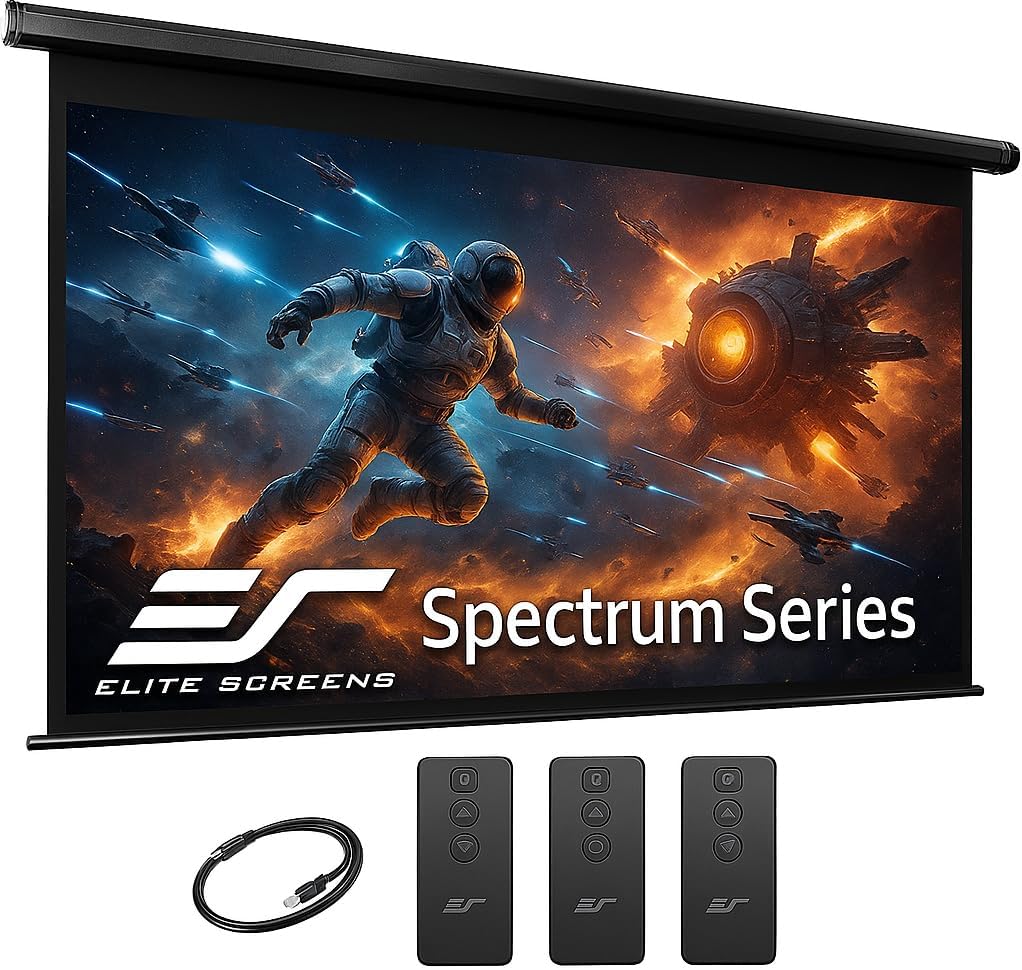
Elite Screens Spectrum
Why it made the list: The Spectrum uses a tubular motor and offers IR and RF remotes, a wall control, and a 12-volt trigger, which makes it easy to integrate with a universal remote or home automation system.
Key specs: 105-inch 16:9 (as reviewed); MaxWhite 2, 1.1 gain; 180-degree viewing angle; tubular motor; 12-volt trigger, IR and RF remotes, and wall control; 2-year warranty.
Skip it if: You want the largest image. The VMAX2 is available in bigger sizes.
Pros
- Several control options for automation.
- Wide rated viewing angle.
- Elite’s warranty terms are clearly published.
Cons
- Elite’s older pages describe different control options.
- Non-tensioned surface.
- Smaller size as reviewed than the VMAX2.
VIVIDSTORM S PRO
Why it made the list: The S PRO rises from a floor case instead of dropping from the ceiling, which suits ultra short throw projectors that sit on a cabinet below the screen. Its tensioned ALR surface stays flat and helps in rooms with ceiling lights.
Key specs: 100-inch (as reviewed), 72 to 130 inch sizes; UST ALR material, 0.6 gain; 170-degree viewing angle; DC tubular motor; tensioned floor rising design; recommended for projectors with at least 1,800 real ANSI lumens.
Skip it if: Your projector is ceiling mounted. Choose a drop-down screen like the VMAX2.
Pros
- Floor rising design needs no ceiling mounting.
- Tensioned ALR surface.
- Clear projector brightness guidance.
Cons
- Works only with ultra short throw projectors.
- Low gain needs a bright projector.
- Takes floor space in front of the wall.
Pyle 72-inch Motorized Screen
Why it made the list: The Pyle screen is a small motorized screen with hooks for wall or ceiling mounting and an aluminum case, so it can move between a classroom, an office, and home. It includes a wireless remote and a wired control box.
Key specs: 72-inch; 4:3 format; 1.3 gain matte white (Pyle listing); motorized with wireless remote and wired control box; wall or ceiling hooks; aluminum case.
Skip it if: You are building a home theater. A 16:9 screen like the Elite Spectrum fits better.
Pros
- Compact and portable for a motorized screen.
- Remote and wired controls included.
- Easy hook mounting.
Cons
- 4:3 format, so a 16:9 image will not fill the screen.
- Small 72-inch size.
- Specifications come from the retail listing only.
Electric Projector Screens Compared
| Screen | Mounting | Gain | Aspect ratio | Trigger | Warranty |
|---|---|---|---|---|---|
| Elite Screens VMAX2 | Wall or ceiling | 1.1 | 16:9 | 5 to 12 V | 2 years |
| Elite Screens Spectrum | Wall or ceiling | 1.1 | 16:9 | 12 V | 2 years |
| VIVIDSTORM S PRO | Floor rising | 0.6 (ALR) | 16:9 | Not stated | Not stated |
| Pyle 72-inch | Wall or ceiling hooks | 1.3 | 4:3 | Not stated | Not stated |
How We Picked
We compared motorized screens from established makers on surface material, mounting style, control and trigger options, warranty, and size. Every pick was assessed from manufacturer documentation, not our own measurements, and rated with the PJC Score.
How to Choose an Electric Projector Screen
Plan power and mounting first
You need an outlet or a hardwired connection near the screen and solid wall or ceiling structure to mount it. Recessed in-ceiling installations usually need a contractor.
Look for a trigger
A 12-volt trigger lets the screen lower when the projector powers on. Check that your projector has a trigger output or use a remote-based alternative.
Tensioned or standard
Tensioned screens hold the surface flatter, which matters with ultra short throw projectors and high gain materials.
Match the aspect ratio
Most home theaters use 16:9. Presentation screens are sometimes 4:3 or 16:10.
FAQ
Are motorized screens worth it?
Yes, if the screen covers a window, TV, or artwork you want to use when not watching. Otherwise a fixed frame gives a flatter surface for less.
Can a motorized screen be used with an ultra short throw projector?
Standard drop-down screens can show waves that ultra short throw projectors exaggerate. Floor rising tensioned screens are a better match.
How long do screen motors last?
Makers rarely publish motor life. Check the warranty, which is two years on the Elite models here.
Final Thoughts
The Elite Screens VMAX2 is our top electric screen for most home theaters. The Elite Spectrum suits automation, the VIVIDSTORM S PRO is built for ultra short throw projectors, and the Pyle screen is a compact portable option.
About the author
Brandon Russell writes projector reviews and buying guides for ProjectorChannel. He compares projectors, screens, and accessories using manufacturer specifications and documentation, and focuses on the trade-offs that matter in a real room.